


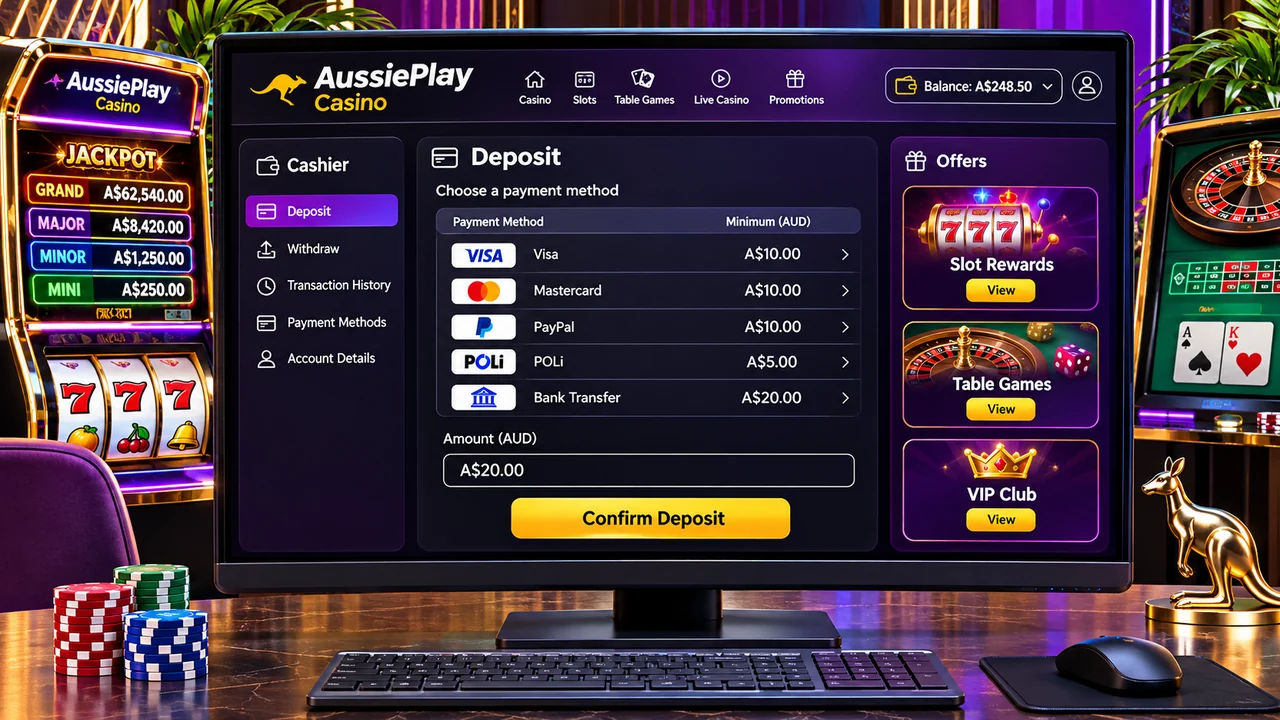
Which clause sets a min 10 deposit casino floor
The number is not an editorial choice made once for the whole site. It lives in the banking or payments section of the terms, almost always as a table with one row per method, and it is reproduced on the cashier screen where it may differ because the cashier is updated first. A banner and a clause that disagree is not a grey area: the clause applies, and the live cashier is the current expression of it.
The reason the floor varies by rail is transaction cost. A flat charge the operator pays per transfer is immaterial on a large deposit and a loss on a small one, so each rail gets its own threshold. That is also why the lowest figure in the table tends to appear in advertising while the rail most Australians use sits a row or two higher.
| Source | How current it is | Weight |
|---|---|---|
| Cashier screen after login | Current, and specific to your account currency | Governs. This is the figure that applies to you |
| Banking or payments page | Usually current, occasionally stale | Indicative. Useful for comparing rails before registering |
| Terms and conditions | Normally includes a right to change limits without notice | Governs the framework, points back at the cashier for figures |
| Promotion landing page | Written for acquisition, not for accuracy | No weight for cashier limits; see the next section |
| Comparison or review page | A snapshot of a date, often not stated | No weight. Useful only as a starting shortlist |
The practical habit worth forming is to read the cashier before registering wherever the site allows it, and otherwise immediately after. The layout of that table on a typical interface is covered in our payments overview, with the limit-and-fee structure set out in fees and limits.
The qualifying deposit and the cashier minimum are different numbers
This is the most common misreading of a low-deposit page, and it costs readers the thing they came for. The cashier minimum is the smallest amount the operator will accept. The qualifying minimum is the smallest amount that triggers a promotion. They live in different documents, they are set by different teams, and the second is frequently larger.
The consequence is specific. A ten dollar deposit can be entirely valid, credited in full, and attached to no bonus whatsoever, because the welcome offer required more. Nothing has malfunctioned; two different clauses did exactly what they say. If a promotion is the reason you are depositing, the qualifying figure is the number to find first, and it sits in the promotional terms rather than the banking terms.
- Find the qualifying minimum in the promotion terms, in the same currency your account is held in.
- Check whether the offer excludes particular payment methods. E-wallets appear on exclusion lists more often than any other rail, which is enough to disqualify a perfectly good deposit.
- Check whether a code is required, and at which step it is entered. Codes applied after the deposit usually cannot be applied at all.
- Read the turnover base before claiming: turnover on the bonus alone and turnover on deposit plus bonus are very different obligations from a ten dollar start.
Our guide to reading bonus terms quickly gives the order to search a terms document in, and valuing a welcome offer covers how to put a figure on what is being offered. The turnover arithmetic itself is in wagering requirements.
Bet sizing: what a A$10 balance can actually run
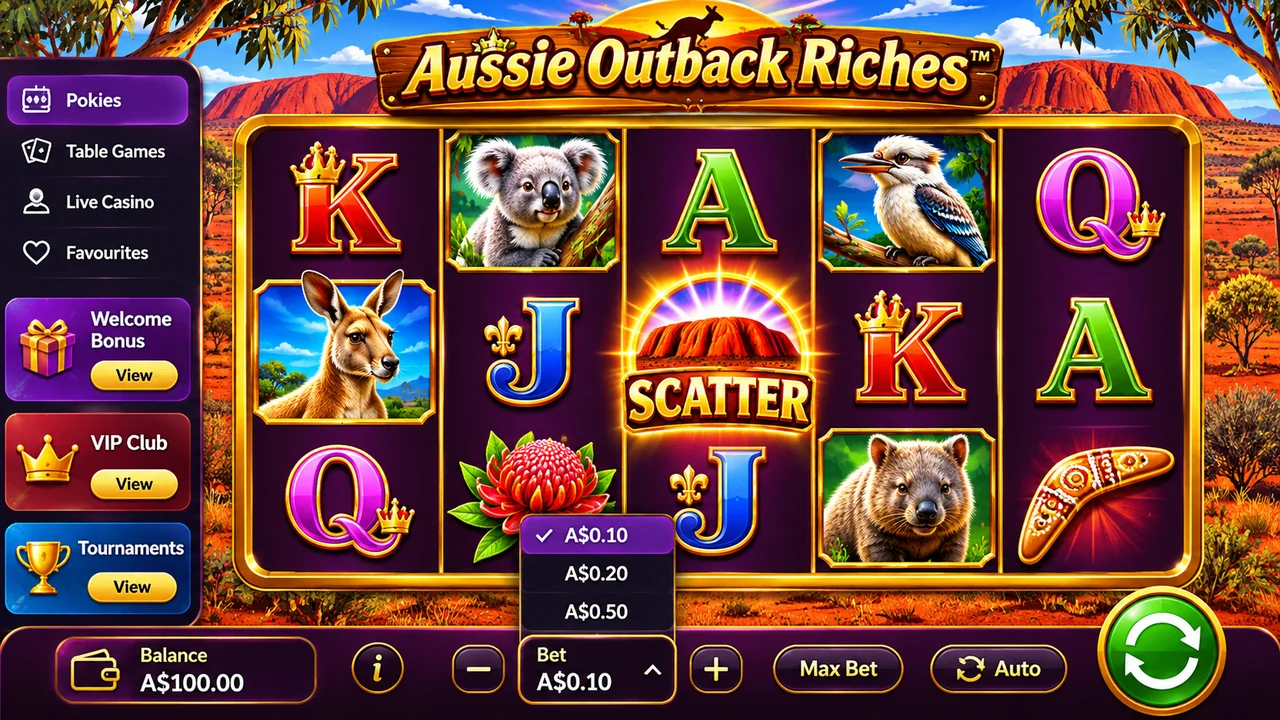
At this size the only variable you control is the stake, and it determines everything else about the session. The arithmetic is a division and it is worth doing before rather than during.
Ten dollars at twenty cents a round is fifty rounds before any returns are counted. At fifty cents it is twenty. At a dollar it is ten, which is not a session but a single decision repeated. Returns extend all of these in practice, and on a lower-volatility title they extend them meaningfully, but the opening ratio sets the frame and no amount of game selection changes it.
| Stake per round | Rounds funded | Practical reading |
|---|---|---|
| A$0.10 | 100 | Minimum stake on many pokies; long enough to see the game behave |
| A$0.20 | 50 | A workable short session on a lower-volatility title |
| A$0.50 | 20 | One dry run ends it |
| A$1.00 | 10 | Not a session at this balance |
Volatility is the second lever and it matters more here than at any larger balance. A high-volatility pokie distributes the same long-run return into rare, larger payouts, and fifty rounds is far too few to meet one. A lower-volatility title returns smaller amounts more often, which is what keeps a short bankroll alive. The distinction is set out in game volatility, and what the return percentage does and does not promise over a short run is in RTP explained. Setting the stake and a stop point before you open the game is the whole of the method described in bankroll planning.
What a A$10 balance cannot reach
Some parts of a casino lobby have their own floors, set by the game rather than the cashier, and ten dollars sits below several of them. Knowing which in advance avoids funding an account for something you cannot then do.
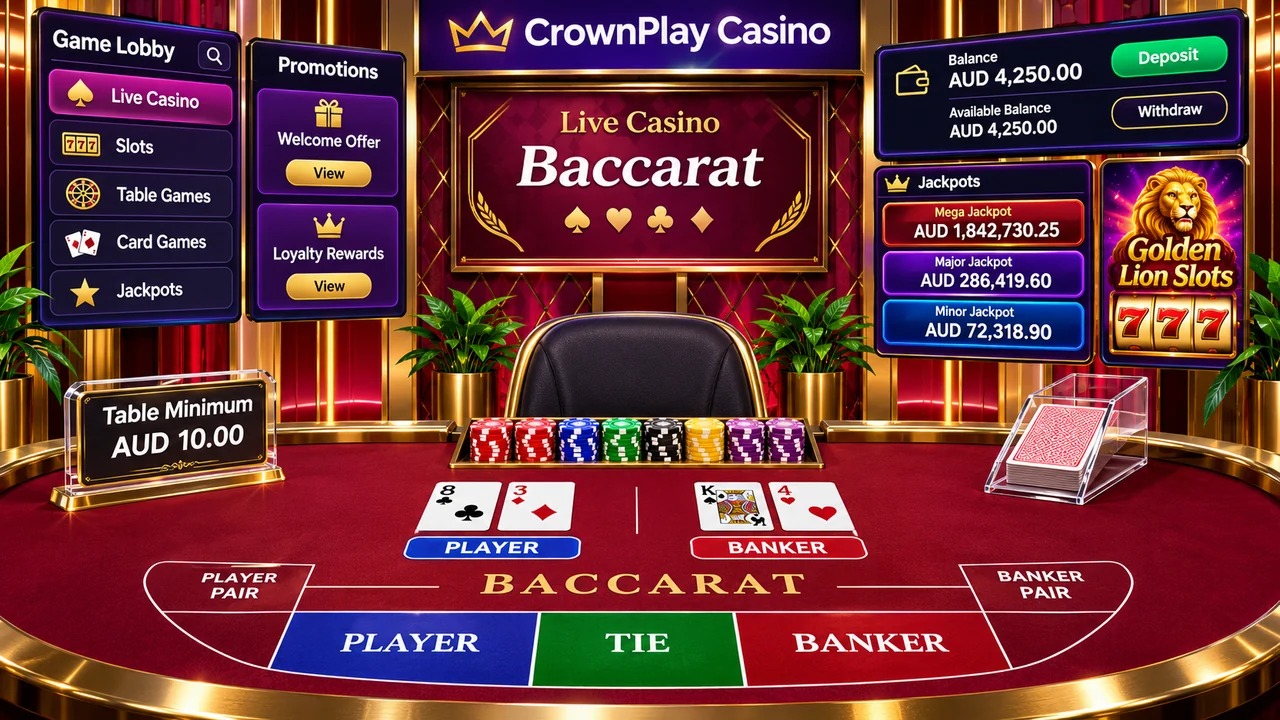
- Live dealer tables. Minimum bets at live tables are set by the studio and are commonly well above the minimum stake on a pokie. The rules panel at each table states its own range; see live casino games.
- Progressive jackpot qualification. Many progressive games require a qualifying stake or a side bet before the jackpot is in play at all, and a sub-qualifying bet can win everything except the pool. The contribution and qualifying rules are in jackpot games.
- Feature purchases. Bonus-buy prices are a multiple of the stake, and the multiple is large enough that a ten dollar balance affords at most one purchase at the smallest stake, with nothing left to continue on.
- Higher-limit table games. Blackjack and roulette variants aimed at larger stakes carry their own minimums, which is a product decision rather than a restriction on you.
None of this makes the tier pointless. It makes it a pokies tier, played at or near minimum stake, and the lobby is wide at that level. It is worth deciding what you intend to play before choosing the deposit size, rather than discovering the constraint afterwards; the categories and their usual stake ranges are summarised in online pokies.
Currency, conversion and the cost that never appears on a banner
A balance displayed in Australian dollars is not proof that the account is held in them. Display currency and settlement currency are separate concepts, and where they differ a conversion happens on every movement in and out, at a rate and spread set by whoever performs it.
At ten dollars the absolute amount is small. The reason to care is not the amount but the asymmetry: the spread applies on the way in and again on the way out, and it is invisible because it is embedded in the rate rather than itemised as a fee. A deposit that credits slightly less than you sent is usually this, not an error. The clause to read is the currency clause in the banking terms, and the behaviour is described in how AUD display and conversion work.
Who performs the conversion mattersIf your bank converts, the rate appears on your statement and you can see what it cost. If the operator or the payment processor converts, the rate is theirs and typically less visible. If both do, in sequence, you pay twice. Where the cashier offers a choice of account currency, choosing the one your bank holds removes the problem entirely, and that choice is often only available at registration.
Fees at the A$10 level: who pays, and which clause says so
Most operators do not charge a deposit fee, and that is worth confirming rather than assuming. Fees cluster on the way out, and at this size a flat charge is a visible share of the balance.
| Charge | Who levies it | Where it is written |
|---|---|---|
| Deposit fee | Usually nobody; occasionally the payment processor | Banking terms, and the cashier confirmation screen |
| Withdrawal fee | The operator, as a flat amount or a percentage | Withdrawal clause in the banking terms |
| Second-payout fee | The operator, where more than one payout falls in a period | Withdrawal clause, often a sentence below the first fee |
| Conversion spread | The bank, the processor, or both | Currency clause; not itemised anywhere as a fee |
| Network fee | The blockchain, on crypto rails | Not an operator charge at all; see crypto payments |
| Dormancy or inactivity charge | The operator, after a stated period of no activity | A separate clause, easy to miss, worth finding if you plan to leave a balance |
The last row is the one readers meet unexpectedly. A balance left untouched for a long period can attract an administration charge under an inactivity clause, which is precisely the position a stranded sub-minimum balance ends up in. If a small remainder cannot be withdrawn, it is better to know whether it will erode. The full cost picture is laid out in fees and limits, and rail-specific behaviour in bank transfers and e-wallets.
The way out: the payout floor and the matching clause
A deposit floor tells you how to get in. Two other clauses decide whether you can get out, and they are the ones a low-deposit page is least likely to quote.
The first is the withdrawal minimum. It is a separate figure from the deposit minimum and is often higher, which means a balance that finishes below it cannot be requested at all. The second is the method-matching rule, under which a payout must return by the route the deposit arrived on, for anti-money-laundering reasons. Together they produce the situation worth anticipating: a deposit made on a rail that cannot receive payouts, leaving a balance that has to exit by a different method with a different and possibly higher floor.
- Read the withdrawal minimum before depositing, and compare it with the deposit minimum. If it is higher, you now know what the balance has to reach.
- Read the matching rule, then check whether your deposit rail can receive money at all. Prepaid vouchers generally cannot.
- Check the payout fee and whether a second payout within a period costs more. Consolidating one withdrawal rather than two is usually cheaper.
- Complete identity verification before you request anything. The documents are the same whenever they are asked for, and asked for at the moment of a payout they become a delay; the list is in verification and KYC.
- Note the timestamp when you submit, and remember the stated processing window normally starts from approval rather than submission. What the claim measures is explained in reading a processing claim.
- If it sits in pending longer than the stated window, follow the escalation order in pending withdrawals rather than opening a second request.
Why ownership details matter at every one of those steps, and what happens when the name on an instrument does not match the account, is set out in payment method matching.
A min 10 deposit casino next to the A$5 and A$20 tiers
The three tiers differ in kind rather than degree, because each sits in a different relationship to the payout floor and to promotional thresholds.
| Around A$5 | Around A$10 | Around A$20 | |
|---|---|---|---|
| Rails that accept it | Few, typically instant bank transfer or vouchers | Most rails, though not always cards | Effectively all rails |
| Against the payout floor | Almost always below it | Frequently below it | Usually at or above it |
| Flat fee as a share | Large enough to matter | Visible | Minor |
| Promotion eligibility | Rarely qualifies | Sometimes; check the figure | Usually qualifies |
| What it realistically funds | A look at the lobby | A short pokies session at minimum stake | A session with some stake flexibility |
Read the table as a guide to choosing deliberately, not as an argument for depositing more. If ten dollars is the figure you set, a promotion that requires more is a promotion to skip. The number should be decided before the cashier is open; deciding it in front of the cashier is how it stops being your number.
Verification does not scale with the deposit
A small deposit buys no reduction in paperwork. Identity and source-of-funds checks attach to the account and to the regulatory obligations of the operator, not to the size of the transaction, and the documents requested at ten dollars are the documents requested at any amount.
- Proof of identity: a current government photo document, with the name spelled exactly as it appears on the account.
- Proof of address: a recent utility bill or bank statement, usually within a stated number of months.
- Proof of payment instrument: evidence that the card or account used belongs to you, with sensitive digits covered as the operator instructs.
- Occasionally a selfie or liveness check, held under the operator's privacy policy rather than yours.
Two consequences follow for a low-deposit reader. First, registering with document-exact details costs nothing at the time and prevents the most common payout refusal later. Second, a ten dollar deposit still involves handing over a full identity file, which is a real cost worth weighing before you decide a site is worth trying at all. The privacy side is covered in our verification review, and definitions of the terms used in these clauses are in the glossary.
A short read before the first A$10
Everything above condensed into checks that can all be done before money moves.
- Read the deposit minimum for your rail on the cashier screen, in your account currency.
- Read the withdrawal minimum and confirm a small balance has a route out.
- Read the payout fee, and whether a second payout in a period costs more.
- Confirm which currency the account is settled in, not just displayed in.
- Check the matching rule against the rail you intend to deposit with.
- If a promotion is the point, find the qualifying minimum, the turnover base, the weighting table and the stake ceiling. Weighting is covered in game weighting and the ceiling in maximum bet rules.
- Decide the stake, and therefore the session length, before opening a game.
- Complete verification while nothing depends on it.
- Look for an inactivity clause if you expect to leave a balance behind.
- Save a dated screenshot of the limits and the bonus terms as you read them.
One piece of context to finish. The Interactive Gambling Act 2001 prohibits the supply of online casino-style gaming to people in Australia, which means a site offering online pokies to an Australian account is not locally licensed and no Australian regulator can recover funds on your behalf. The framework is set out in our note on the Act. None of it changes the arithmetic on this page; it changes what the records you kept are worth if you ever need them. For adults aged 18 and over: set the figure you are comfortable losing before you start, and keep to it.
A$10 deposits: questions worth a straight answer
Can I really deposit only ten dollars?
At most cashiers an Australian can reach, yes, but the floor is set per payment method rather than site-wide. The figure that governs your account is on the cashier screen after login, in your account currency. A rail that advertises a lower minimum elsewhere may still sit above ten dollars for you.
Will a A$10 deposit qualify me for the welcome offer?
Often not. The qualifying minimum is written in the promotional terms and is a different number from the cashier minimum, frequently a larger one. A deposit below it is credited normally with no bonus attached, which is the clauses working as written rather than a fault.
Can I withdraw what is left of a ten dollar deposit?
Only if the balance clears the withdrawal minimum, which is a separate figure and is often higher than the deposit minimum. Check it before depositing, along with the payout fee and the rule about which method a payout must return on. Below the floor, no request can be submitted.
Which payment method suits a small deposit best?
An instant bank transfer or PayID generally costs you nothing per transaction and clears quickly between Australian accounts, which suits a small amount; the details are in our PayID notes. Prepaid vouchers cap your exposure but usually cannot receive a payout, so a withdrawal would need a second method. Crypto avoids bank declines but charges a network fee per transfer, which takes a larger share of a small amount.
Is the account really in Australian dollars?
Check the currency clause rather than the balance display. Where the account is settled in another currency, a conversion spread applies on the way in and again on the way out, embedded in the rate rather than shown as a fee. Choosing an AUD account at registration, where that choice exists, removes the issue.
Does a smaller deposit mean lighter verification?
No. Checks attach to the account and to the operator's regulatory obligations, not to the transaction size, so the document list is the same at ten dollars as at any amount. The only thing that changes is when the request arrives. Completing it before you play turns a payout into an administrative step rather than a negotiation.
READ BEFORE ACTING
Risk note
These definitions describe common industry usage; the operator’s own wording governs and it can change without notice.
Your next step
Explore the current offer
Compare the offer details, payment options and account terms at your own pace.