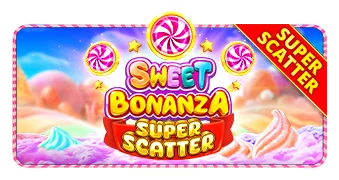
Sweet Bonanza Super Scatter is best understood as a distinct variation within the candy series. The familiar scenery helps recognition, but the special scatter introduces a condition that needs its own explanation. A complete review should tell the reader what kind of event the symbol belongs to, rather than rely on its colour or size.
- Matching system
- Anywhere-pay candy symbols
- Feature entry
- 4–6 scatters
- Initial feature
- 10 free spins
- Distinctive condition
- Super Scatter at the feature trigger
Specification basis: Pragmatic Play product documentation.
The special symbol depends on context
The provider describes matching groups across the field and a feature started by four to six scatters. Additional outcomes associated with Super Scatters depend on their presence while the feature is triggered. The special symbol is therefore part of a condition, not an isolated promise attached to its artwork.
This is the key distinction to preserve in an explanation. A symbol-only crop cannot establish the surrounding state. A useful illustration needs either the complete triggering arrangement or a clearly written description of the condition being discussed.
A tumble and a trigger are different events
Tumbles replace qualifying symbols within a sequence. A feature trigger changes the active phase. Those events can appear close together visually, but they should not be described as the same operation.
The difference resembles the distinction between updating a view and entering another mode in an ordinary application. An update changes what is currently shown; a mode transition changes the rules that govern subsequent interactions. The analogy helps organise the description without suggesting that a reader controls the random sequence.
The title should travel with the image
Candy symbols and lollipops are shared visual identifiers across the series. They are insufficient to tell the editions apart when an image is separated from its original page. The full title should therefore remain in the text near the image and in the image's descriptive alternative text where relevant.
This article treats the Super Scatter edition on its own. That avoids a common editorial error: borrowing a numerical limit from a numbered sequel while describing the special-symbol rules of a different release. Similar cover art makes that error easy to miss.
Three useful distinctions
| Term | What it describes |
|---|---|
| Ordinary symbol group | Part of the regular field evaluation. |
| Feature trigger | A condition that changes the active phase. |
| Super Scatter | A special symbol evaluated in that trigger context. |
Reading a value label without over-reading it
A value attached to a special event tells the reader something about that event's specification. It does not, on its own, tell them the likelihood of meeting its condition. A table of possible labels is not a probability table.
The distinction is important for an independent review because a product image often prioritises the most visually dramatic label. Our analysis instead asks what the label modifies, when it applies and which edition defines it. Those questions produce a clearer explanation than arranging large numbers from smallest to largest.
An illustrated comparison needs different jobs
The artwork provides identity; a terminology table explains roles; the prose explains conditions. Giving each element a specific job prevents the review from becoming a repeated description of the same colourful image.
Our conclusion is that the special-scatter condition deserves the centre of the article. The tumble structure is familiar context, while the conditional role of the new symbol is the actual point of distinction. This gives the page a separate purpose from the Sweet Bonanza 2500 review in the same collection.
Questions about Sweet Bonanza Super Scatter
Does the Super Scatter work independently of the trigger?
The provider describes its additional outcome in the context of triggering the feature.
Why are the editions reviewed separately?
Their shared scenery conceals meaningful differences in the rule being emphasised.
Does a listed event value reveal its probability?
No. A value and the chance of its qualifying condition are different pieces of information.
Source notes
The feature descriptions refer to Pragmatic Play’s documentation for Sweet Bonanza Super Scatter. The interface analysis is our editorial interpretation. Source material checked on 24 September 2026.
Game imagery: Pragmatic Play. Read about sources, illustrations and review scope.